 THE UNIVERSITY OF CHICAGO


February Session
- Long Paper or Honors Thesis?
- Overview of the Honors Program: timeline, required courses (PLSC298 & 299)
- FAQ's: Double Majors BA/MA students, Study Abroad, etc.
- The Application Process
The application will be available on the political science department website in late February, due by the end of 3rd week of Spring Quarter which is Friday, April 10th
Presented by:
James Wilson, Director of Undergraduate Studies, dus-polsci@uchicago.edu
Patricia Conley, Honors Program Coordinator and Assoc. DUS, pconley@uchicago.edu
The Political Science Major has two different writing requirement options:
The Long Paper: at least 20 pages, usually an extension of a paper submitted for a political science class; a chance to do original analysis or analyze secondary sources; students applying to grad school sometimes use the long paper as their writing sample.
The Honors Thesis: 35 – 50 pages, for students who already have some depth and methodological training, and a specific, focused research question or topic.
Note: Students in BA/MA programs fulfill their writing requirement with the MA thesis
The BA thesis is an original contribution to knowledge in a subfield of political science. It is a chance for you to apply the knowledge and skills you have gained in your undergraduate classes to a topic that you are passionate about. Here are examples of topics:
- What is Plato’s conception of education in The Laws, and how does this help us think about the dangers of polarization for democracy today?
- Is vote fraud in Russia based on manipulating turnout or vote share, and does the level of fraud vary by region and city?
- To what degree does the US use higher education as a ‘soft power’ to promote their policy goals in Latin America?
- Why did the United States, during the unipolar moment, act against its long-term strategicinterest by choosing not to invest in its commercial shipbuilding industry?
- Have changing patterns of Puerto Rican migration affected election outcomes and public policy in Florida?
- Was US action in the 1973 Yom Kippur War a Cold War motivated geo-political move or Nixon’s response to domestic political pressures?
What makes for a successful honors thesis experience?
Preparation: You have taken the introductory course and at least one advanced course in your area of interest. Your methodological and language skills match your proposed research design.
Motivation: You are not solely motivated by getting a credential. You are truly interested in researching and writing about a topic.
Spring Quarter 2026: Complete Application and Secure Faculty Advisor by 4/10/26
The Associate DUS will organize workshops for newly accepted honors students to form plans for summer reading and research.
Autumn 2026: Enroll in PLSC298 BA Colloquium
Note: You cannot study abroad and enroll in PLSC298.
Winter 2027: Enroll in PLSC299 Thesis Supervision
An independent study with your faculty advisor for a full course credit; it is possible to enroll in PLSC299 in Spring quarter; there are no fixed meeting times.
Spring 2027: 35-50 paged thesis due by Monday of the 5th week of Spring quarter
Plus 3 of the 4 Introductory courses, PLSC22913 Research Methods,
+ 6 additional Political Science electives (because 298 & 299 count as electives; the long paper track requires 8 electives because those students do not enroll in 298 & 299)
- Spring Quarter:
- Secure a Faculty Advisor and submit a formal application by the end of the 3rd week of Spring Quarter (4/10/2026)
- After acceptance into the program, attend small group meetings with Assoc. DUS to prepare for summer reading and research.
- Meet with Faculty Advisor to settle on Summer Reading/Research Plan.
- Reading the Literature/Refining Research Question
- IRB/CITI training if needed for interviews/ethnography/experiments
- Investigating Sources of Data
- Lecture once a week: Statement of Problem, Research Question, Literature Review, Research Methods, etc.
- Small Group meetings once a week (5-8 students per section) organized roughly by field of interest, led by a Preceptor. Students discuss their projects and provide feedback on each other’s work.
- Assignments: Small writing assignments building up to a 20 paged draft due at the end of the quarter (Intro, Statement of Problem, Literature Review, Methods) ; PowerPoint presentations to small group.
- Preceptors lead the small groups, provide feedback on student work throughout the quarter; meet at least twice during the Winter quarter; and serve as a second reader, evaluating the thesis for honors in the Spring Quarter.
- The goal is to help students create a substantial draft of the front end of their thesis and get them ready to jump into the intensive research and writing of Winter quarter.
PLSC298 Canvas Course Site: Links and Resources for Writing and Methods, Previous Honors Theses, etc.
The Canvas site stays open from September - June
- Register for PLSC299 BA Thesis Supervision, meeting regularly with Faculty Advisor
- Intensive Analysis and Writing!
- Complete rough draft of the thesis due to preceptor and faculty advisor by the end of Winter quarter
- Final revisions during first four weeks.
- The final version of the BA thesis is due by Monday of the fifth week of Spring Quarter. Your faculty advisor and preceptor determine honors. Your faculty advisor assigns the grade for PLSC299 after the thesis is submitted.
- Honors requires an outstanding GPA and an honors-deserving thesis. Students with an overall GPA of 3.0 or higher and a major GPA of 3.6 or higher at the beginning of Spring quarter will be awarded honors if the BA thesis is given a grade of B or higher.
- You must go through the Political Science honors program application process to have your thesis evaluated for honors in political science.
- You must enroll in PLSC298 and PLSC299 even if you are participating in an honors colloquium in another department for your double major.
- While students may use one thesis for two majors, it is often easier to write a thesis for one major rather than two because there may be different literatures, standards, and thesis formats across departments.
You can study abroad this Spring and participate in the honors program, so long as you meet the deadlines for submitting your application and securing a faculty advisor.
Students writing an honors thesis may not study abroad in Autumn quarter since this is the only quarter when PLSC298 is offered. You must be in residence and working on your thesis.
Though not encouraged, studying abroad in the Winter of your senior year is permitted if your faculty advisor agrees and you meet the program deadline for submission of a full rough draft (end of Winter quarter).
The honors thesis is always due by the Monday of the 5th week of the quarter in which you graduate. If you graduate at the end of Winter 2027, you will be on an accelerated schedule – your thesis will be due by Monday of the 5th week of Winter quarter. You will still need both PLSC298 and PLSC299 (you can register for PLSC299 in the Autumn Quarter if needed). Students graduating in Winter 2027 should notify Prof. Conley after they are accepted into the honors program to set goals for the summer and fall.
If you graduate in Summer 2027, you follow the schedule outlined above (298,299, rough draft due at end of Winter Quarter) but the final version of your thesis will not be due until the Monday of the 5th week of summer quarter.
Extended status means that you are not enrolled in courses and have reduced tuition in the Spring quarter, but you still graduate in June. You will follow the usual BA thesis schedule, taking PLSC298 in the Autumn and PLSC299 in the Winter. Your thesis is still due by Monday of 5th week of Spring quarter.
An MA thesis fulfills the writing requirement for the undergraduate major. In other words, if you write a Master’s thesis you do not need to write a long paper or honors thesis in addition. However, the department does not automatically evaluate MA theses for undergraduate honors. You need to apply to the undergraduate honors program and participate in PLSC298 and PLSC299 to have your MA thesis evaluated for honors. See the Department Website for additional details.
Part I: Your Proposed Topic and Background
Here’s what we want to know: Do you have a clear idea of what you want to do and are you prepared to carry out the research? The honors program does not help you figure out a topic, and it does not teach you new methods. You must come to the program with your question and the research skills that you need.
These are the questions on the online application:
- Why is it important to you to write a senior thesis as opposed to a long paper?
- What is your proposed topic or specific research question?
- What are the specific data sources or texts that you will use for your research? What is your research design?
- List courses that you have taken in political science and other departments that are directly relevant to your proposed thesis topic. (Include course number, title, and instructor last name)
- List any methods courses, research papers, and research/internship experiences that have provided you with experience regarding the methodological approach you will most likely use for your thesis.
DO NOT PANIC! We understand that your answers are your best guess at the time of application!
Students applying to the honors program must secure a faculty member to serve as the main advisor for their project.
- We recommend that students work with faculty in the political science department.
- Faculty advisors outside of the department are allowed if their area of expertise is directly related to the student’s research topic.
- Only regular faculty and lecturers can advise honors theses. Advisors may not be visiting faculty, teaching fellows, or graduate students (but graduate students and visiting faculty CAN advise long papers).
- You can talk to potential advisors as you narrow your question and think about your application. After you settle on an advisor, they should see your application before they sign off on it.
More Frequently Asked Questions:
- Can I ask someone to be my advisor even if I never had a class with them? (YES)
Is it okay to ask for someone’s time and advice even if I don’t end up asking them to be my advisor? (YES, within reason)
What if I change my topic slightly or later find someone else who would be better? (You can switch faculty advisors, but not after the middle of Autumn Quarter).
Faculty Advisor Form: The form can be found here.
Your topic of interest has likely emerged from one or more of your previous classes. You may already be aware of major controversies, empirical and theoretical puzzles, sources of data, and current research on your specific topic. If not, the library resources below can help you figure out gaps in the academic literature and possible sources of data.
One of the best places to start researching a topic is to look at review articles where scholars summarize the main theoretical questions and approaches taken in subfields of political science. These can help get you get up to speed on the major debates in your field of interest. Here are two sources:
For both sources, you can search general topics like “education policy,” “religion and politics,” “Puerto Rico,” or “media and politics.” For the Oxford Handbooks, you can scroll down the page to go to a specific handbook (Oxford Handbook of Political Theory, Oxford Handbook of US Social Policy, Oxford Handbook of Modern Diplomacy, Oxford Handbook of American Public Opinion and the Media, etc.) and/or use the search bar to look for chapters on your topic across different volumes.
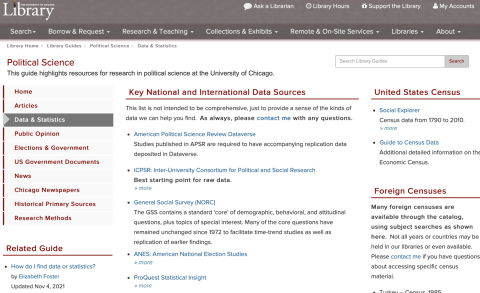
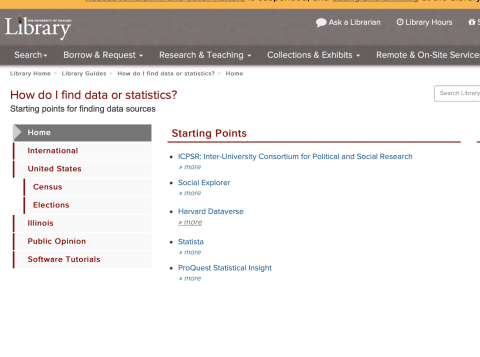
FYI: Sources of Data in Political Science:
The Regenstein Library Political Science Subject Page has links to these sources as well as national and international data sources.
https://guides.lib.uchicago.edu/polisci
https://guides.lib.uchicago.edu/data
Google data search:
https://datasetsearch.research.google.com/
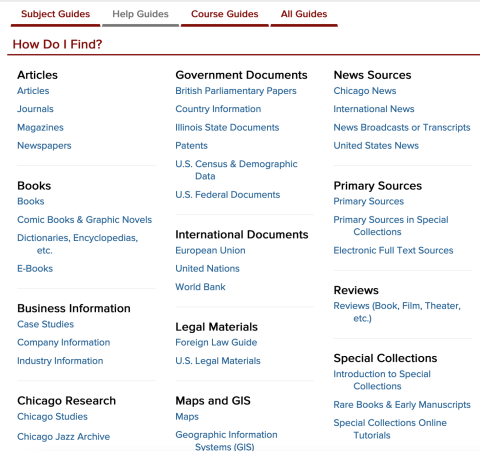
For Qualitative Data and Primary Sources, go to “Help Guides” instead of “Subject Guides”:
Any Questions?
Feel free to contact us if you have any questions as you go through the application process:
James Wilson, Director of Undergraduate Studies, dus-polsci@uchicago.edu
Patricia Conley, Honors Program Coordinator, pconley@uchicago.edu